
While Mount Kilimanjaro is the highest point in Africa, the Rwenzori Mountains—historically known as the “Mountains of the Moon”—are widely considered the continent’s ultimate trekking challenge.
Stretched along the border of Uganda and the DR Congo, the Rwenzoris are not volcanic like their cousins in Kenya and Tanzania. Instead, they are a massive block of jagged crystalline rock rising over 5,000 meters. In 2026, the Rwenzoris remain a “bucket list” item for serious mountaineers, offering a prehistoric landscape of glaciers, rare flora, and legendary mud.
1. Why the “Mountains of the Moon”?
The name dates back to the ancient Greek geographer Ptolemy, who described a snow-capped range in the heart of Africa as the source of the Nile. For centuries, it was dismissed as a myth—until explorers finally confirmed the existence of these glaciated peaks on the Equator.
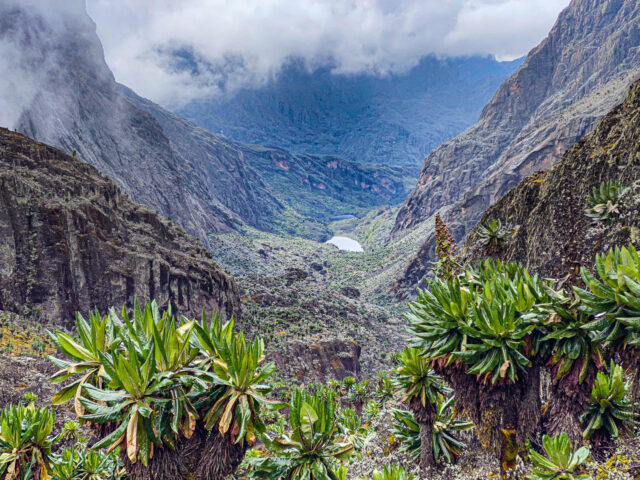 Today, the Margherita Peak (5,109m) on Mount Stanley stands as Africa’s third-highest point. However, unlike the dusty scree of Kilimanjaro, the Rwenzoris are a lush, water-logged “botanical big game” park.
2. Choosing Your Path: The Two Main Routes
In 2026, two primary trekking circuits offer different experiences:
-
The Central Circuit (Managed by RMS): The traditional, historic route. It’s a 7-to-9-day loop that takes you through the heart of the Bujuku Valley. It is famous for its iconic “bogs” and a slightly more “raw” wilderness feel.
-
The Kilembe Trail (Managed by RTS): Reopened and modernized over the last decade, this route is often praised for its superior scenery and more gradual ascent, which aids in acclimatization. It features well-maintained wooden boardwalks over the deepest mud.
3. The “Botanical Big Game”: A Surreal Landscape
The most striking feature of a Rwenzori trek isn’t the summit; it’s the vegetation. As you ascend, you pass through five distinct zones:
-
Montane Forest (1,600m – 2,500m): Towering trees, ferns, and the chance to hear (or see) Chimpanzees and Rwenzori Turacos.
-
Bamboo Zone (2,500m – 3,000m): A dense, misty forest where the trail often disappears into a tunnel of bamboo.
-
Heather Zone (3,000m – 4,000m): Giant heathers draped in “Old Man’s Beard” (lichen) create an eerie, haunted-forest atmosphere.
-
Alpine Moorland (4,000m – 4,500m): Home to the Giant Lobelias and Groundsels—prehistoric-looking plants that can grow up to 6 meters tall.
-
The Rock and Ice (4,500m+): The world of permanent glaciers and jagged peaks.
4. Technical Demands: Is it for You?
Let’s be candid: the Rwenzoris are tougher than Kilimanjaro.
-
The Mud: You will hike in rubber boots (gum boots) for a significant portion of the trek. The “Bigo Bog” can swallow a hiker up to their waist if they miss the path.
-
Technical Climbing: To reach Margherita Peak, you must use crampons, ropes, and ice axes. While your guides will teach you the basics, a high level of physical fitness and mental resilience is mandatory.
-
Success Rate: Because of the wet conditions and physical strain, the success rate for the summit is lower than other African peaks, though modern gear in 2026 has made it significantly more achievable.
5. 2026 Trekking Costs and Logistics
| Item | Estimated Cost (USD) | Notes |
| 7-9 Day Summit Trek | $1,300 – $1,800 | Includes guides, porters, food, and huts. |
| Park Entrance Fees | $35 per day | Paid to Uganda Wildlife Authority (UWA). |
| Gear Rental | $100 – $200 | Crampons, harnesses, and ice axes. |
Accommodation: Forget tents. On both major routes, you stay in wooden mountain huts. In 2026, many of these have been upgraded with better solar lighting and improved bedding, though they remain rustic.
6. Pro-Tips for the Rwenzori Trekker
-
Embrace the Wet: It rains even in the “dry” season. High-quality waterproof layers and “dry bags” for your electronics are non-negotiable.
-
Hire an Extra Porter: For $15–$20 a day, an extra porter can make the difference between a miserable slog and an enjoyable expedition.
-
Acclimatize: Don’t rush. The 8-day itinerary is much more successful than the 6-day “express” versions.
Final Thought: Reaching the glaciers of the Rwenzoris is like stepping back in time. It is one of the few places left on Earth where you can stand on a peak and look out over a landscape that feels completely untouched by the modern world.